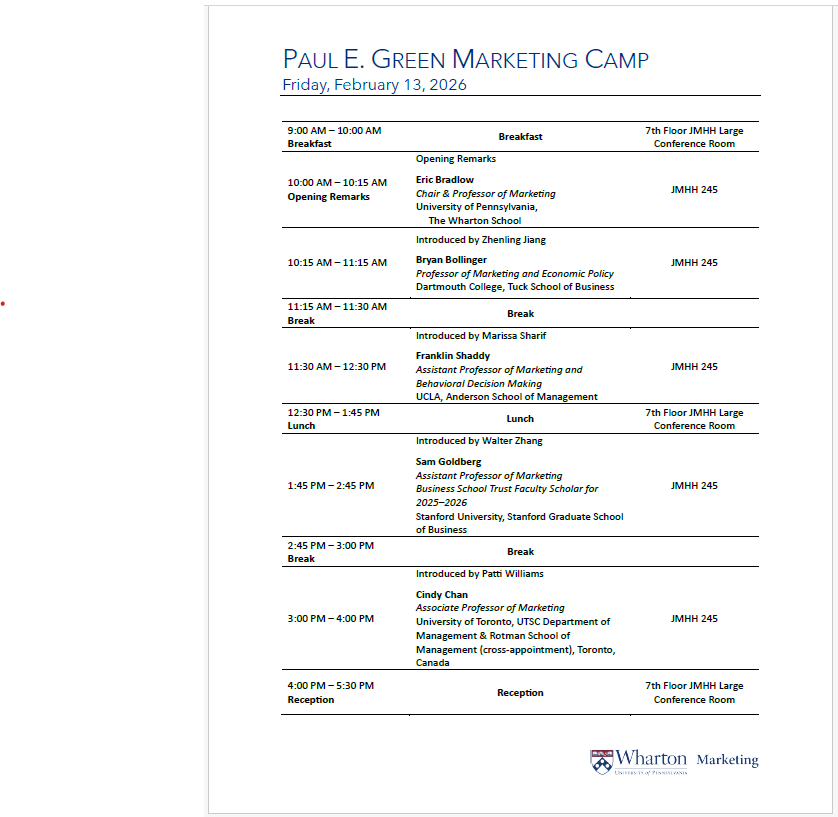

Friday, February 13, 2026
Wharton’s annual Paul E. Green Marketing Camp brings four leading scholars in the field of Marketing together to share their cutting-edge research and interact with our faculty, students, and researchers. The day celebrates the diversity of the marketing field, with talks spanning the wide spectrum of marketing research topics and guests joining us from around the world. By bringing some of the most brilliant minds in the field together with our Wharton Marketing scholars, we aim to foster creativity, spark new research, and continue pushing the frontiers of marketing knowledge.
We are appreciative that Paul E. Green’s first PhD student, and Deane W. Malott Professor of Management Emeritus, Cornell University, Johnson Graduate School of Management, Vithala R. Rao, and his wife Saroj have endowed Wharton’s Marketing Camp and named it in Paul’s honor.
If you have any questions, please get in touch with Professor Zhenling Jiang or admin Beth McCarthy.
Bryan Bollinger

Bryan Bollinger, Professor of Marketing and Economic Policy
Dartmouth College, Tuck School of BusinessMore
Professor Bollinger is a Professor of Marketing and Economic Policy at Dartmouth Tuck School of Business. He was formerly a Professor of Marketing at NYU Stern School of Business where he served as the Academic Director of Doctoral Studies. His interdisciplinary research portfolio aims to understand the causal effects of marketing and policy decisions and the interdependent reactions by consumers and firms. His research has been supported by grants from the Department of Energy, National Science Foundation, Environmental Protection Agency, and others, and it has been highlighted in news outlets such as `The Economist’, `NPR’, `The New York Times’, and `The Harvard Business Review’. Professor Bollinger in an incoming Coeditor at Journal of Marketing Research and has also served on the editorial review boards at, Journal of Marketing (area editor), Quantitative Marketing and Economics (area editor), Marketing Science, and Journal of Consumer Research. He received his B.A. and B.E. in engineering at Dartmouth College and his M.A. in Economics and Ph.D. in Marketing at Stanford University.
Self- and Social Signaling: Evidence from Solar Adoption in California
Prosocial behavior plays a role in many economic contexts and has been explained by altruism, social pressure, signaling, and expectations of fairness and reciprocity. We examine prosocial behavior in a context that allows us to distinguish the role of self-signaling and social signaling from alternative explanations, including warm glow. Our context is residential solar, and selfsignaling is separately identified from social signaling by the exogenous visibility of potential solar arrays. We show that the political affiliation of proximate peers influences the extent of self-signaling and is crowded out by the private benefits of installing solar.
Cindy Chan

Cindy Chan, Associate Professor of Marketing, Department of Management
University of Toronto- ScarboroughMore
Cindy Chan is an Associate Professor of Marketing at the University of Toronto. Her research examines the social and emotional lives of consumers, with a particular interest in shared consumption experiences and prosocial giving. Her research has received several awards and recognitions, including the Robert Ferber Award from the Journal of Consumer Research and Best Paper Award from the Journal of Consumer Psychology, and has been featured in major media outlets such as The New York Times, The Wall Street Journal, and NPR. She is also an award-winning teacher and was voted Professor of the Year by her students. She is #WhartonProud and grateful to have completed her PhD at the Wharton School at the University of Pennsylvania.
In Lieu of Gifts: Why Charitable Gift Requests Lead to Less Generous Giving
Prosocial behavior comes in a variety of forms, each governed by distinct norms. This research investigates the intersection of two such forms: charitable giving and gift giving. People increasingly use special occasions (e.g., weddings, birthdays) to solicit donations to charitable organizations in lieu of more typical gifts. We examine how the norms associated with gift giving versus charitable giving shape responses to such requests. Across an analysis of archival gift registry data (N = 9,458) and five pre-registered experiments (N = 3,976), this research shows that, without intervention, givers are less generous toward charitable gift requests relative to more prototypical cash gift requests. This discrepancy in generosity occurs because charitable gift requests do not directly benefit the intended recipient, thereby activating the spending norms for charitable giving, rather than the typically more generous spending norms associated with gift giving. This difference is amplified in the context of rite-of-passage occasions, such as weddings, where a gift’s direct benefit is particularly important, rendering charitable gift requests even less prototypical. We further demonstrate that emphasizing how a recipient might directly benefit from a charitable gift request makes such requests feel more prototypical, leading givers to follow gift (vs. charitable) giving norms.

Sam Goldberg, Assistant Professor of Marketing, Business School Trust Faculty Scholar for 2025–2026
Stanford University, Stanford Graduate School of BusinessMore
Goldberg is an assistant professor of marketing at Stanford Graduate School of Business. His work seeks to better understand the role of privacy, data, AI, and monitoring technologies in markets. He holds a PhD from Kellogg School of Management at Northwestern University and undergraduate degrees in economics and physics from Brandeis University. Prior to his PhD, Goldberg served as an associate economist at the Federal Reserve Bank of Chicago.
What is Online Privacy Worth? Evidence from an Information Provision Experiment
Firms commonly exploit consumer biases and information frictions — hiding costs and manipulating choices — prompting regulators to mandate transparent information disclosure, with the goal of increasing salience and easing to interpretation. We quantify the welfare effects of two disclosure mechanisms in online privacy via a two-month, large-scale field experiment. Using a custom built browser extension to track online behaviors, consumers were randomized to one of two treatments: (1) condensed, personalized summaries of each website’s privacy practices; or (2) more prominent, easily accessible privacy-policy links. We use our extension and the experimental variation to measure the causal impact of information disclosure’s on beliefs about privacy practices, website choices, and privacy seeking behaviors. Our design allows us to separately identify consumer preferences for privacy from site quality and systematically document experienced privacy online. Overall, our results shed light on the welfare effects of disclosure regulation in an important market and allow us to quantify the consumer value of online privacy.
Franklin Shaddy

Franklin Shaddy, Assistant Professor of Marketing and Behavioral Decision Making
UCLA, Anderson School of ManagementMore
Franklin studies judgment and decision making in the marketplace, with a particular focus on causes and consequences of consumers’ fairness perceptions. He teaches Marketing Management (core) in the full- and part-time MBA programs. He received the Dean George W. Robbins Assistant Professor Teaching Award in 2020, the Eric and “E” Juline Faculty Excellence in Research Award in 2022, and was named a Best “40-Under-40” Business School Professor by Poets&Quants in 2023. Franklin holds a Ph.D. from The University of Chicago Booth School of Business, an M.A. from Columbia University, and a B.B.A. from the University of Michigan. He was previously a management consultant at PwC Advisory Services and before that an investment banking analyst at JPMorgan Chase & Co.
People Endorse Harsher Policies in Principle Than in Practice: Asymmetric Beliefs About Which Errors to Prevent Versus Fix
Countless policies are crafted with the intention of punishing all who do wrong or rewarding only those who do right. However, this requires accommodating certain mistakes: some who do not deserve to be punished might be, and some who deserve to be rewarded might not be. Six preregistered experiments (N = 3,484 U.S. adults) reveal that people are more willing to accept this trade-off in principle, before errors occur, than in practice, after errors occur. The result is an asymmetry such that for punishments, people believe it is more important to prevent false negatives (e.g., criminals escaping justice) than to fix them, and more important to fix false positives (e.g., wrongful convictions) than to prevent them. For rewards, people believe it is more important to prevent false positives (e.g., welfare fraud) than to fix them , and more important to fix false negatives (e.g., improperly denied benefits) than to prevent them.